April 2026 highlighted a rapid shift from AI experimentation to large-scale deployment across global enterprises. Key themes of the month included the mainstream adoption of autonomous agents, landmark enterprise AI announcements at Google Cloud Next, significant global investments in AI infrastructure, a strong focus on secure and trustworthy AI development, the expansion of predictive analytics in decision-making, and AI’s growing role in streamlining healthcare operations.
April 2026: AI News Highlights
1. Autonomous AI Agents Become Mainstream 1

April saw growing adoption of autonomous AI agents capable of planning, reasoning, and executing tasks with minimal human supervision. Businesses are increasingly integrating these systems into operations, customer support, and workflow automation.
The capability of these agents to negotiate workflows across multiple applications has revolutionized front-office and back-office operations. Rather than acting as simple conversational interfaces, these systems execute complex processes such as customer dispute resolutions and real-time inventory management with exceptional speed.
This development signals a new era in software design, where autonomous agents act as middleware that connects disparate business systems. By taking on routine planning and execution, agentic workflows are freeing up human capital to focus on high-value strategy and creative problem-solving.
2. Google Cloud Next 2026 Showcases Enterprise AI Innovation 2
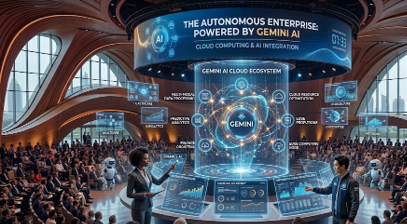
At Cloud Next 2026, Google unveiled major AI advancements, including enhanced Gemini capabilities and enterprise AI solutions. The announcements emphasized AI-powered productivity, data analytics, and workflow automation for businesses.
The highlight of the conference was the deep integration of Gemini into Google Workspace and Google Cloud Platform, providing developers and business users with native coding assistance, advanced data analytics, and contextual collaboration tools. These features are designed to minimize latency and friction in software delivery.
By offering pre-built agent frameworks and security guardrails, Google is positioning its cloud platform as the primary operating system for enterprise AI. This move intensifies competition in the cloud market, driving developers and enterprises to adapt to unified AI ecosystems.
3. AI Infrastructure Investment Continues to Rise 3

Organizations worldwide increased investments in AI infrastructure, including specialized chips, cloud computing resources, and data centers. The growing demand for AI services is driving one of the largest technology infrastructure expansions in recent history.
The massive surge in compute demand has led to significant investments in specialized hardware accelerators and next-generation cooling systems for data centers. Tech giants and venture funds are pouring billions into ensuring that infrastructure capacities keep pace with the exponential growth of foundation models.
This infrastructure boom underscores the strategic importance of computational sovereignty and energy efficiency. As countries and corporations race to secure raw compute power, the focus is shifting toward sustainable power sources and optimized chip architectures to handle future AI workloads.
4. Trustworthy AI Becomes a Strategic Priority 4

Companies are increasingly focusing on secure and transparent AI systems. Enterprises are implementing governance frameworks to ensure compliance, security, and ethical deployment as AI becomes central to business operations.
The deployment of autonomous agents has heightened risks around data leakage, algorithmic bias, and non-compliance with privacy regulations. In response, organizations are establishing dedicated AI safety boards and deploying automated auditing tools to monitor model decisions in real-time.
This push for trustworthy AI represents the maturation of corporate governance in the digital era. By embedding safety and transparency into the core design of AI systems, businesses are protecting themselves from legal liability while building long-term trust with their customers.
5. AI Enhances Business Decision-Making 5

Advanced AI analytics platforms are helping organizations make faster and more accurate decisions by processing vast amounts of structured and unstructured data. Businesses are leveraging predictive insights to optimize operations and customer experiences.
Modern AI tools can synthesize diverse data sources, from market reports to operational metrics, providing real-time recommendations for inventory pricing, supply chain logistics, and marketing campaigns. This helps leaders respond dynamically to market shifts rather than relying on historical reviews.
This intelligence-driven approach is transforming corporate strategy, shifting business models from reactive planning to proactive optimization. As predictive engines become more integrated, data-driven decision-making is becoming a standard requirement for competitive organizations.
6. AI in Healthcare Expands Beyond Diagnostics 6

Healthcare providers are increasingly using AI for patient management, treatment planning, administrative automation, and operational efficiency. The technology is becoming an integral part of modern healthcare delivery.
In clinical workflows, AI systems are assisting clinicians by automatically summarizing complex patient records, predicting patient readmission risks, and generating customized treatment outlines. This reduces administrative overhead, allowing doctors to dedicate more quality time to direct care.
The shift from diagnostic tools to comprehensive operational systems marks a major phase in digital health. As healthcare systems integrate AI into scheduling, patient triage, and resource allocation, they are building highly responsive, efficient systems that improve patient outcomes.
Core Considerations for AI’s Practical Integration
As AI transitions from breakthrough announcements to widespread deployment, several critical themes emerge:
- Mainstream Agentic Systems: The transition of autonomous agents from experimental pilots to core operational layers across enterprise workflows.
- Enterprise Ecosystem Integration: Google’s cloud innovations highlighting unified, secure platforms for building and scaling corporate AI agents.
- Infrastructure Scaling and Sustainability: Unprecedented physical infrastructure expansion driving innovations in energy-efficient hardware and computational capacity.
- A Focus on Trust and Governance: The rising prioritization of AI transparency, compliance audits, and data safety to mitigate risks associated with autonomy.
- Predictive Decision-Making: Leveraging advanced AI analytics to transition from historical business intelligence to real-time predictive optimization.
- Operational Healthcare Transformation: The expanding deployment of AI tools in patient administration, triage, and clinician workflow management.
Conclusion
April 2026 highlighted the rapid shift from AI experimentation to large-scale deployment. Autonomous agents, enterprise AI platforms, and expanding infrastructure investments demonstrate the growing importance of AI in business and healthcare.
As adoption accelerates, organizations are recognizing that trust, governance, and security are just as critical as technological innovation. The success of future implementations will depend on how effectively companies can manage these systems responsibly and securely.