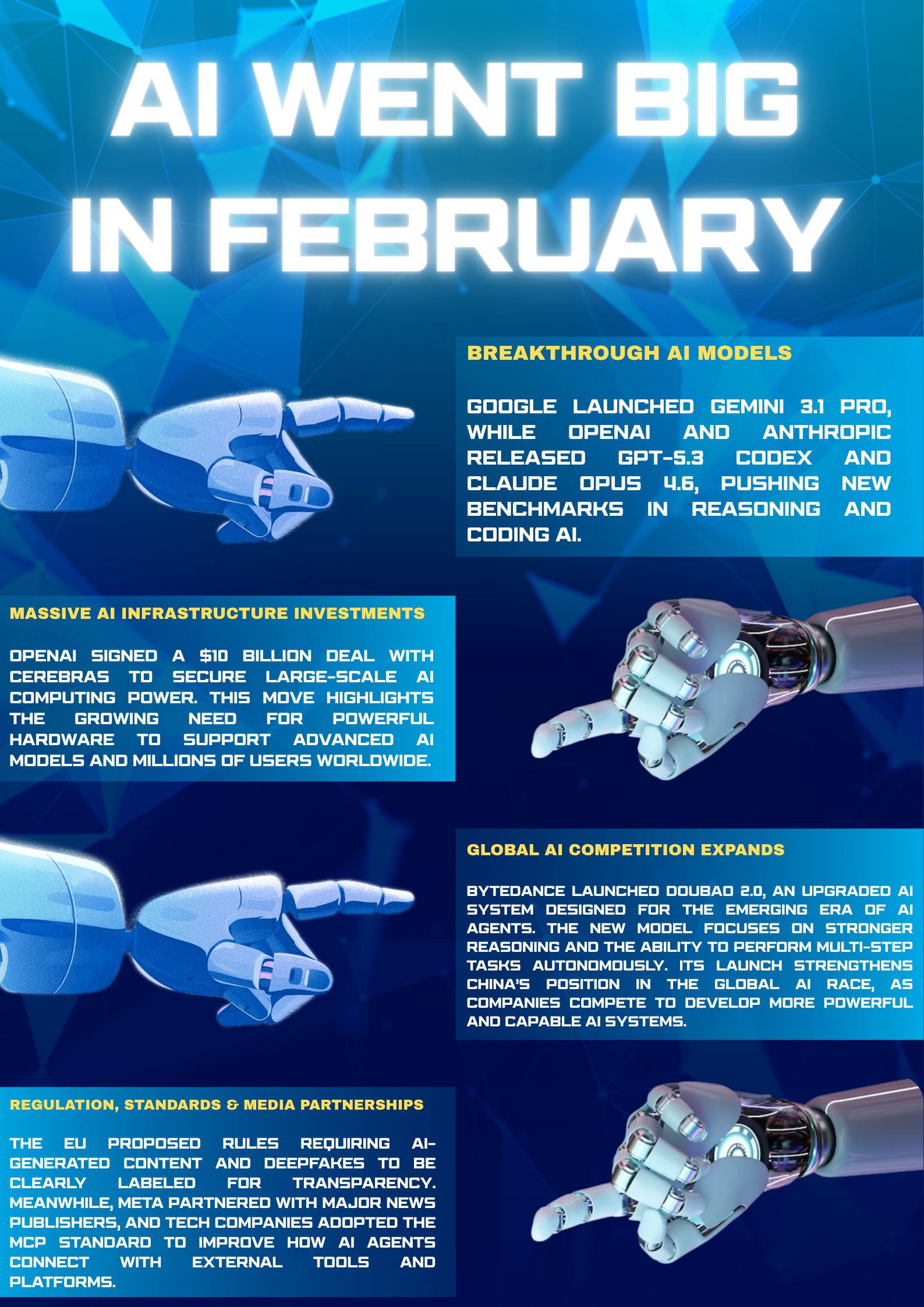
February 2026 marked a defining chapter in the ongoing evolution of artificial intelligence — one driven by record-breaking model performance, billion-dollar infrastructure bets, and the early signs of a maturing regulatory landscape. The month saw Google shatter reasoning benchmarks with a mid-cycle model update, OpenAI and Anthropic launch flagship releases on the very same day, and a landmark open-source protocol achieve cross-industry adoption almost overnight. Meanwhile, ByteDance pushed China’s AI ambitions forward, Meta redrew the line between AI and journalism, and the European Union moved closer to making AI transparency legally enforceable. Here are the 7 biggest AI stories from February 2026 — each with full context and key takeaways.
February 2026: AI News Highlights
1. Google Gemini 3.1 Pro Sets New Benchmark Records 1

On February 19, 2026, Google released its most capable AI model yet — Gemini 3.1 Pro — marking the first time the company has used a “.1” increment between major versions. The move signals a faster, more targeted update cycle aimed squarely at reasoning depth and agentic capability.
The standout achievement is on ARC-AGI-2, a rigorous test of novel logic and pattern recognition — Gemini 3.1 Pro jumped from 31.1% to 77.1%, more than doubling its predecessor’s score. It also achieved 94.3% on GPQA Diamond, beating both Claude Opus 4.6 and GPT-5. Google kept the pricing identical to its predecessor, making it a major upgrade at no extra cost.
A new three-tier “thinking system” (Low/Medium/High) gives developers fine-grained control over the compute-to-depth trade-off — a practical feature for production agentic deployments. The model is available across the Gemini app, NotebookLM, AI Studio, Vertex AI, and Android Studio.
2. OpenAI & Anthropic Drop Major Models on the Same Day 2

February 7 will be remembered as a milestone in the AI calendar: OpenAI and Anthropic launched major model updates simultaneously, creating an instant split-screen comparison for developers and enterprises worldwide.
OpenAI launched GPT-5.3-Codex, a coding-focused powerhouse bundled with a new enterprise tool called “Frontier” — designed to help companies manage and coordinate AI workers across complex workflows. Anthropic countered with Claude Opus 4.6, featuring a massive one-million-token context window and substantially improved coding and instruction-following capabilities.
For developers, the choice between the two comes down to use case: GPT-5.3-Codex shines in complex code generation and automation pipelines, while Claude Opus 4.6 leads in long-document comprehension, enterprise reasoning, and safety-constrained deployments. The simultaneous releases underscored just how fiercely competitive the frontier model space has become.
3. OpenAI Signs $10 Billion Deal with Cerebras for AI Computing 3

In one of the largest AI infrastructure agreements ever signed, OpenAI committed to purchasing up to 750 megawatts of AI computing power over three years from Cerebras Systems, in a multibillion-dollar contract valued at over $10 billion.
The deal deploys Cerebras’ distinctive wafer-scale AI chips — which pack an entire silicon wafer into a single processor — to dramatically accelerate inference for ChatGPT and future OpenAI products. It also signals a strategic diversification away from both Nvidia GPU dependency and exclusive reliance on Microsoft Azure for compute.
Industry analysts viewed the deal as a sign that the AI chip market is maturing rapidly beyond Nvidia dominance, with new specialized hardware providers capturing large enterprise commitments. As OpenAI scales to hundreds of millions of daily users, inference-optimized hardware becomes as strategically important as training compute.
4. ByteDance Launches Doubao 2.0 for the AI Agent Era 4

China’s AI race entered a new chapter as ByteDance — the parent company of TikTok — unveiled Doubao 2.0, a complete rearchitecting of its flagship chatbot designed specifically for the emerging era of AI agents.
The company claims Doubao 2.0’s pro variant matches the top US frontier models on multi-step reasoning and task execution benchmarks, while cutting inference costs significantly. With 155 million weekly active users, Doubao already leads China’s AI assistant market — and the 2.0 launch is a direct shot at maintaining that lead against the surging popularity of DeepSeek and Alibaba’s Qwen models.
“Agent era” positioning means the focus has shifted from answering questions to executing complex, multi-step tasks: scheduling, web research, form-filling, and coordinating across apps — all autonomously. Chinese AI labs are no longer playing catch-up; they’re competing toe-to-toe with US counterparts on both capability and cost.
5. Meta Signs AI Licensing Deals with CNN, Fox News & Major Publishers 5

Meta struck a series of multi-year commercial licensing agreements with major US and international news publishers — including CNN, Fox News, USA Today, The Daily Caller, Washington Examiner, and Le Monde — to power its Meta AI chatbot with real-time news content.
Under the deals, Meta AI can now deliver live news-based responses across Facebook, Instagram, WhatsApp, and Messenger — with attribution and direct links back to the publisher’s websites. The arrangements are framed as a partnership rather than a scraping arrangement, with publishers receiving licensing fees in exchange for structured content access.
The deals represent a significant shift in the media-AI relationship: rather than fighting over copyright, major publishers are monetizing their content through structured licensing — a model that could become the industry standard. For Meta, live news access makes its AI substantially more useful for billions of daily users.
6. EU Releases Draft AI Transparency Code — Deepfakes Must Be Labeled 6
The European Commission released the first draft Code of Practice on AI Transparency under the EU AI Act, setting out binding requirements for how AI-generated and AI-manipulated content must be disclosed to the public.
The Code requires all providers of AI systems to mark AI-generated content — including deepfakes, synthetic voice, AI-written text, and AI-altered images or video — in machine-readable, detectable, and interoperable formats. The standards are designed to enable automatic detection by browsers, platforms, and third-party fact-checkers.
A second draft is expected in March 2026, with the Code to be finalized and enforceable by June 2026. Non-compliance could result in fines of up to €35 million or 7% of global annual turnover. Global tech companies operating in Europe — including US-based AI labs — will be directly impacted.
7. Anthropic’s MCP Goes Mainstream — OpenAI, Google & Microsoft Adopt It 7

In a landmark moment for the open-source AI ecosystem, Anthropic donated its Model Context Protocol (MCP) to the Linux Foundation — and within weeks, OpenAI, Microsoft, and Google all formally announced adoption of the standard.
MCP is a universal protocol that allows AI agents to seamlessly connect to external databases, APIs, business tools, and file systems — enabling them to carry out complex, multi-step tasks independently. Think of it as the “USB standard” for AI agents: once a tool supports MCP, any MCP-compatible agent can use it across vendors and platforms without custom code.
The cross-industry adoption is unprecedented. Having all three major AI labs plus Microsoft rally behind a single open standard suggests the real competition has moved to who can build the most capable agents on top of that shared foundation. The move also positions Anthropic as an ecosystem builder, not just a model maker — a strategic shift with long-term dividends.
Core Considerations for AI’s Practical Integration
As AI transitions from breakthrough announcements to widespread deployment, several critical themes emerge:
- Reasoning Benchmarks: Gemini 3.1 Pro setting new limits on logic-focused tasks like ARC-AGI-2.
- Frontier Coding Wars: Simultaneous launches from OpenAI and Anthropic escalating competitive capabilities in coding and reasoning.
- Infrastructure Diversification: OpenAI’s $10 billion wafer-scale compute commitment to Cerebras, shifting reliance away from Nvidia.
- Autonomous Agent Ecosystems: ByteDance’s Doubao 2.0 scaling cost-effective multi-step agent actions in the Chinese market.
- Publisher Licensing Models: Meta signing structured content deals with news outlets, altering the media copyright landscape.
- Global Transparency Enforcement: The EU releasing binding drafts for labeling AI-generated content and deepfakes.
- Open Standards for Agents: Anthropic’s Model Context Protocol (MCP) becoming the industry standard, supported by Google, Microsoft, and OpenAI.
Conclusion
February 2026 will be remembered as the month AI stopped being a research experiment and started behaving like mature infrastructure — governed by standards, constrained by regulation, and shaped by billion-dollar commercial agreements.
The model wars have become multi-dimensional: it is no longer just about who has the highest benchmark score, but who has the best pricing strategy, the most reliable agentic workflows, the strongest ecosystem partnerships, and the most robust compliance posture. Gemini 3.1 Pro’s near-doubling of ARC-AGI-2 scores in a single point release shows that the pace of reasoning improvements has itself accelerated dramatically.
The Cerebras deal and Meta’s publisher agreements point to AI’s rapid commercialization — infrastructure and content are now being locked into long-term contracts. The EU transparency code signals that the regulatory window is narrowing globally, and companies that delay compliance planning do so at their peril.
Most significantly, MCP’s cross-industry adoption represents a rare moment of collaboration in a fiercely competitive space. When rivals agree on a shared standard, it usually means the real battleground has shifted — in this case, to who can build the most powerful, reliable, and trustworthy AI agents on top of that foundation. The next chapter of this story, beginning in March 2026, promises to be even more consequential.