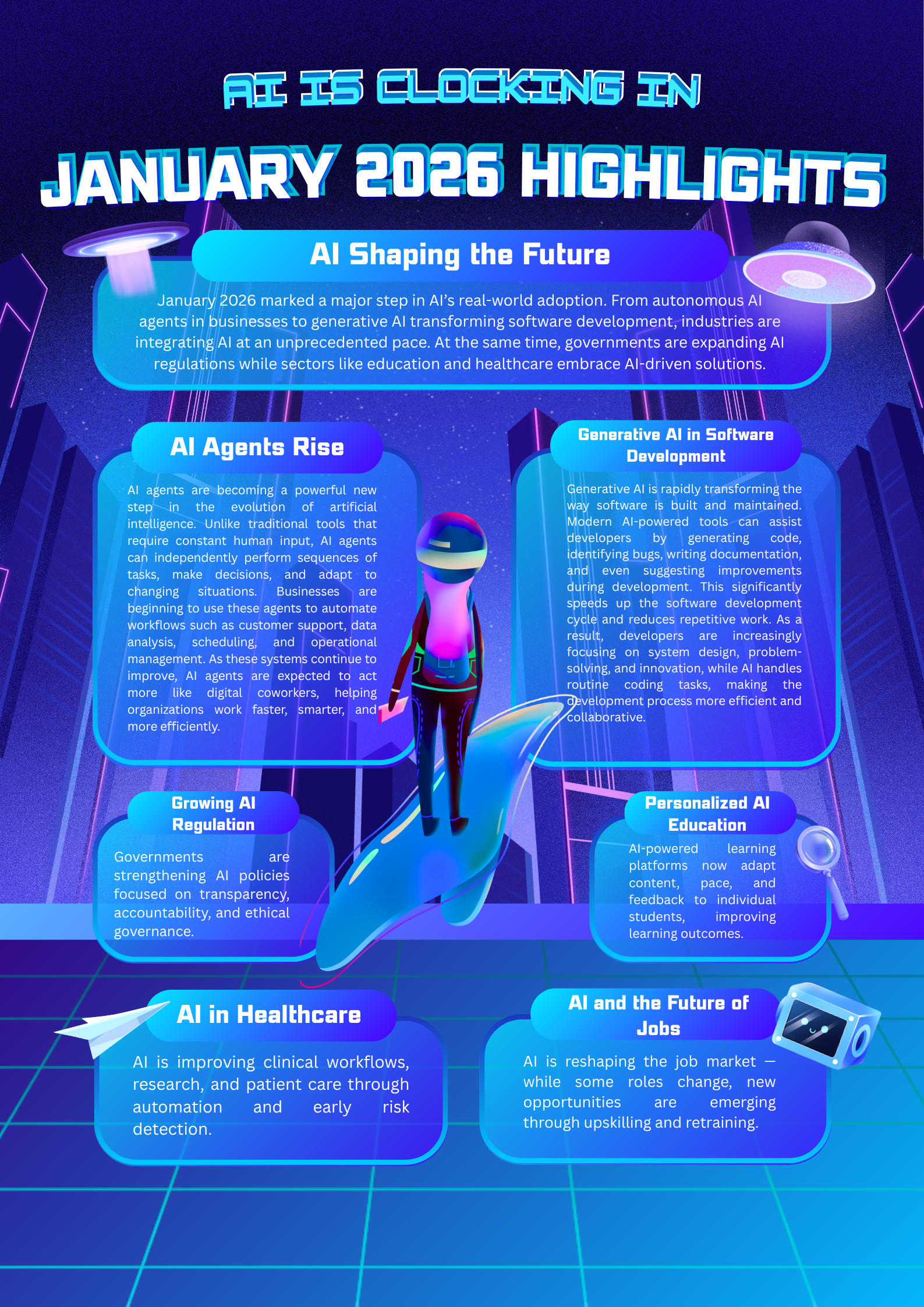
January 2026 marked a significant step forward in the evolution and practical deployment of artificial intelligence. Key themes of the month included the real-world expansion of AI agents, accelerated generative AI software development, expanding regulation discussions, adaptive personalized education, healthcare workflow transformations, and AI’s deep impact on the global jobs landscape.
January 2026: AI News Highlights
1. AI Agents Broaden Real-World Use 1
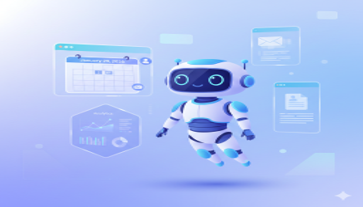
AI agents — autonomous systems that can perform sequences of tasks with minimal human supervision — are increasingly moving from research into practical enterprise use. Industry analyses show that organizations are adopting agent-based tools for operations, finance, and service workflows as AI becomes foundational rather than experimental.
The significance of this transition lies in the shift from static assistants to dynamic, goal-oriented collaborators. By integrating agentic workflows directly into core business platforms, enterprises are automating multi-step processes like invoice processing, customer onboarding, and supply chain tracking, which previously required constant human intervention.
This development represents a key step towards systemic AI orchestration, where individual agents communicate and collaborate to solve complex business problems. As these agents become more reliable and context-aware, they are redefining operational efficiency and setting a new standard for workplace automation.
2. Software Development Accelerated by Generative AI 2

Generative AI isn’t just for writing text — in early 2026 it’s becoming deeply integrated into software development environments. Developers are using AI tools for code generation, debugging, documentation, and automated testing, significantly reducing cycle times and shifting the engineering role toward design and oversight.
The impact of these tools is particularly evident in the automation of routine and repetitive coding tasks. Modern AI-assisted IDEs can suggest entire files, debug complex logical errors in real-time, and write comprehensive test suites, allowing developers to focus on higher-level architecture and system design.
This evolution represents a paradigm shift in software engineering, moving from manual syntax writing to high-level intent translation. As generative AI becomes an essential co-pilot, the barrier to entry for software development continues to lower, while the speed of software delivery accelerates.
3. Regulation and Policy Discussions Expand 3
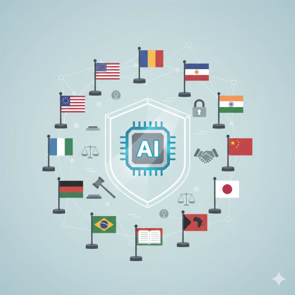
Governments and organizations are sharpening their regulatory frameworks for AI. As AI systems scale in capability and reach, policymakers are focusing on transparency, accountability, risk classification, and governance to guide safe and ethical use across sectors.
This regulatory push is driven by the rapid adoption of agentic and autonomous systems in sensitive domains like finance, law enforcement, and healthcare. Establishing clear guidelines around data usage, bias mitigation, and liability is becoming a top priority for international standard-setting bodies.
The expanding discourse highlights the challenge of balancing technological innovation with public safety. As governments move from high-level ethical frameworks to binding legislative measures, businesses must proactively adapt their development and deployment strategies to ensure compliance.
4. Personalized AI-Driven Education Gains Traction 4

AI-powered personalized learning platforms are advancing rapidly. These systems tailor content and pacing to individual learners, offering real-time feedback and adaptive pathways that help students progress more efficiently while supporting teachers with insights into performance gaps.
By analyzing student response patterns and learning speeds in real-time, these platforms can dynamically adjust instruction styles, offer targeted exercises, and identify areas where a student needs extra assistance, fostering a more personalized and supportive educational environment.
This approach signals a transformation in modern pedagogy, moving away from one-size-fits-all curricula toward learner-centric education. For educators, AI serves as a valuable tool that automates routine grading and offers deep insights, freeing up time for focused, human-centric mentoring.
5. AI Transforms Healthcare Workflows 5
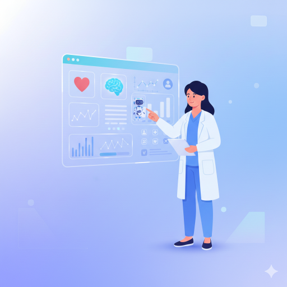
AI’s role in healthcare continues to expand beyond diagnostics to clinical workflows, research, and operational optimization. Clinical leaders report unprecedented adoption of AI tools for patient care, administrative efficiency, and early detection of health risks.
In clinical settings, AI assistants are streamlining time-consuming administrative tasks, such as transcribing patient visits and drafting electronic health records, which significantly reduces clinician burnout and allows healthcare professionals to spend more time directly with patients.
Beyond operational improvements, AI’s ability to analyze massive datasets is accelerating medical research and drug discovery. The integration of predictive AI models into patient monitoring systems allows for early intervention, ultimately improving clinical outcomes and saving lives.
6. AI’s Impact on the Jobs Landscape 6
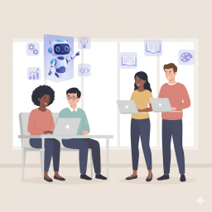
January 2026 featured major discussion on AI’s influence on employment — particularly at events like Davos, where economists and leaders warned of sweeping labor market shifts. While AI may displace some roles, experts emphasize that upskilling, retraining, and new job categories are emerging in parallel as economies adapt.
The focus of global conversations has shifted from fears of total job displacement to the practicalities of workforce transition. Collaborative AI roles, AI security specialists, and prompt-based workflow managers are becoming increasingly common, highlighting the demand for human-AI collaboration skills.
To navigate this transition, organizations and governments are urged to invest heavily in comprehensive upskilling programs. Ensuring that the workforce is prepared to leverage AI effectively is crucial for maintaining economic stability and ensuring that the benefits of automation are shared equitably.
Core Considerations for AI’s Practical Integration
As AI transitions from breakthrough announcements to widespread deployment, several critical themes emerge:
- Autonomous AI Agents: The steady migration of autonomous agents from experimental research to enterprise workflows across operations, finance, and service sectors.
- Developer Acceleration: Generative AI’s deep integration into software development lifecycles, transforming developer roles toward oversight and design.
- Regulatory Frameworks: Sharpening global AI regulations focusing on governance, accountability, and risk classification.
- Personalized Learning: Growth in AI-powered adaptive educational pathways, providing custom instruction and real-time student insights.
- Clinical & Administrative Healthcare: Clinical adoption of AI agents improving diagnostics, patient care, and backend administrative operations.
- Jobs & Upskilling: The ongoing global economic debate on labor displacements and the parallel growth of new categories requiring strategic retraining.
Conclusion
January 2026 highlights a maturing AI ecosystem where the focus is no longer just on raw capability, but on integration, governance, and human impact. As AI agents become coworkers, software builds itself faster, and education and healthcare grow more adaptive, the central challenge remains ensuring that progress is inclusive, ethical, and sustainable.
The year ahead will be defined not by whether AI can do more — but by how responsibly and effectively society chooses to use it.