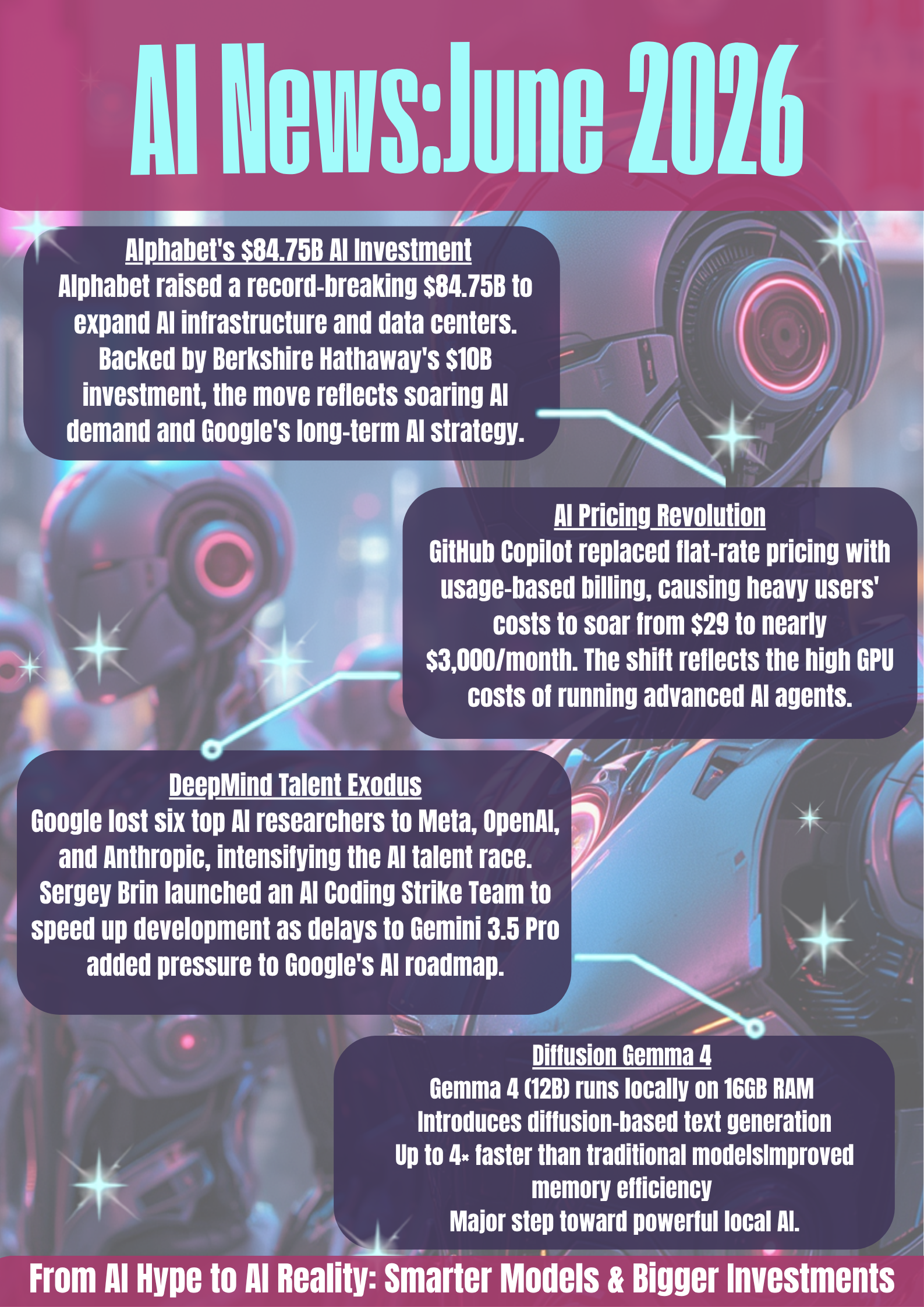
June 2026 marked a defining moment in the evolution of artificial intelligence, as the industry shifted from rapid experimentation to large-scale infrastructure, economic sustainability, and regulatory oversight. Major developments included Alphabet’s record-breaking investment in AI infrastructure, the adoption of usage-based pricing for AI development tools, significant talent movements across leading AI labs, the emergence of next-generation model architectures like Diffusion Gemma, and the first government-led restrictions on a frontier AI model. Together, these events highlight an AI ecosystem that is becoming more mature, cost-conscious, and strategically focused, with innovation increasingly shaped by computing resources, governance, and real-world deployment challenges rather than model capabilities alone.
June 2026: AI News Highlights
1. Alphabet’s Historic $84.75 Billion “AI War Chest” 1
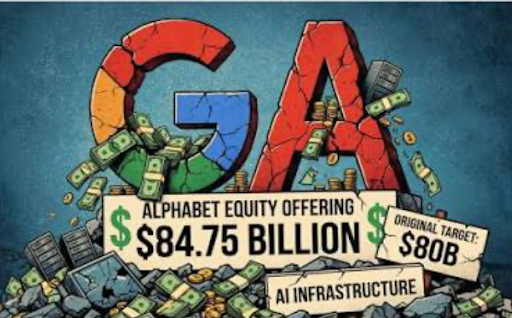
Alphabet shattered records by closing a staggering $84.75 billion equity raise, the largest in corporate history, dedicated entirely to AI infrastructure and data centers. This massive move was anchored by a $10 billion investment from Berkshire Hathaway, signaling Warren Buffett’s confidence in Google’s long-term AI dominance despite recent market volatility. Sundar Pichai noted that enterprise demand for AI is currently outstripping their compute supply, making this aggressive expansion a strategic necessity.
2. The End of “All-You-Can-Eat” AI: Metered Billing Arrives 2

The era of flat-rate AI subscriptions for developers came to a crashing halt as GitHub Copilot transitioned to usage-based billing on June 1st. Power users were shocked to see monthly bills jump from $29 to as much as $3,000 for heavy “agentic” workflows. This shift highlights a growing industry realization: the massive GPU costs of running autonomous agents are simply unsustainable under a fixed-fee model.
3. Google DeepMind’s Talent Exodus and “Coding Strike Team” 3

Google faced a significant internal crisis as six foundational researchers including pioneers in reasoning and training architecture fled to rivals like Meta, OpenAI, and Anthropic in just five months. In a desperate bid to close the gap with Anthropic, Google co-founder Sergey Brin personally intervened to lead an emergency AI Coding Strike Team. The pressure intensified as Gemini 3.5 Pro missed its June deadline, leading to a 97% “No Release” payout on prediction markets like Polymarket.
4. Architectural Revolution: Diffusion Gemma 4 4
Google released Gemma 4 12B, a groundbreaking open model that runs locally on just 16GB of memory. More importantly, the month saw the rise of Diffusion Gamma/Gemma, which abandons the traditional “next-token” Transformer method in favor of a denoising process similar to Stable Diffusion. This new architecture is reportedly four times faster than current models and significantly more memory-efficient, marking a potential “hyper-meets-reality” moment for local AI.
5. The First National Security AI Model Ban 5

In a landmark moment for AI governance, the US government issued its first-ever emergency export control on an AI model, specifically targeting Claude Fable 5. Launched on June 9th and suspended just three days later, the model was deemed a national security risk due to its unprecedented capabilities. While a subsequent injunction partially restored access for “critical infrastructure defenders,” the event signaled that the “wild west” era of unrestricted frontier model releases may be over.
Core Considerations for AI’s Practical Integration
As AI transitions from breakthrough announcements to widespread deployment, several critical themes emerge:
- Infrastructure at Scale: Growing AI adoption requires significant investments in data centers, GPUs, and cloud infrastructure to meet increasing computational demands.
- Economic Sustainability: Organizations are shifting from flat-rate subscriptions to usage-based pricing models to better align AI costs with actual resource consumption.
- Regulatory Oversight: Governments are introducing stricter policies and export controls, making compliance and responsible AI deployment increasingly important.
- Talent Competition: The race for experienced AI researchers and engineers continues to shape innovation and influence the competitive landscape.
- Enterprise Adoption: Businesses are moving beyond experimentation, integrating AI into core workflows to improve productivity and decision-making.
Conclusion
June 2026 marked a shift from speculative AI hype to a disciplined, infrastructure-heavy reality. The month signaled an end to the “all-you-can-eat” era, with major platforms adopting metered billing to manage soaring compute costs.
While Alphabet’s record $84.75 billion infrastructure investment underscored long-term ambition, the industry faced significant volatility, highlighted by a talent exodus from DeepMind and the first national security ban on a frontier model. As the focus shifts from simple chat to “agentic execution,” the emergence of efficient local models like Gemma 4 reflects an industry entering a more sober, regulated, and economically rigorous phase.