May 2026 brought a series of high-profile product announcements and research breakthroughs that solidified AI’s transition into the foundation of modern digital life. Key developments of the month included the landmark announcements at Google I/O 2026, a widespread reevaluation of AI strategies by corporate executives, critical academic research on the evolution of AI search, accelerating breakthroughs in scientific discovery, and the rapid expansion of generative AI adoption into retail, legal, and manufacturing sectors.
May 2026: AI News Highlights
1. Google I/O 2026 Reinforces the AI-First Future 1
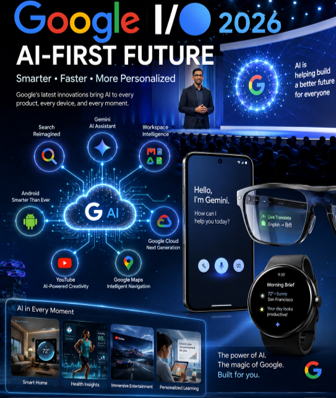
Google’s annual developer conference showcased significant AI enhancements across Search, Android, Workspace, and Gemini. The event demonstrated how AI is becoming the foundation of modern digital experiences.
The event focused on the integration of Gemini Nano with multi-modal capabilities directly into Android, enabling real-time context-aware assistant features on-device. Additionally, major updates to Google Workspace tools highlighted how generative AI can automate email summarization, document drafts, and spreadsheet analysis.
By demonstrating these deep integrations, Google highlighted its vision of an AI-first operating system that acts as an intuitive, proactive assistant. This shift forces competitors to prioritize native AI integration rather than simple API connections.
2. Businesses Reevaluate Their AI Strategies 2
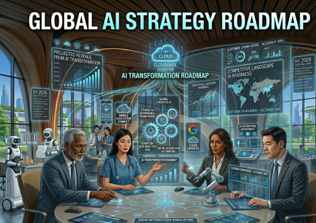
Rapid advancements in AI capabilities are forcing organizations to rethink long-term strategies. Many executives acknowledge that AI roadmaps developed just months earlier require significant revisions to remain competitive.
The swift maturation of autonomous agent systems and reasoning models has made early-stage pilots obsolete. Companies are discovering that they must pivot from basic conversational tools to deep enterprise integration, which requires restructuring internal databases and data flows.
This strategic shift highlights the challenge of planning in a rapidly evolving technological environment. To minimize risks, executives are adopting modular AI architectures that allow them to swap out underlying models as new capabilities emerge.
3. AI Search Continues to Evolve 3

Research released in May examined the growing role of AI-generated search results and summaries. While these tools improve efficiency, experts continue evaluating their impact on information quality, publishers, and user trust.
The shift toward AI-generated summaries at the top of search pages has raised concerns about web traffic redirection and source attribution. Publishers are calling for fairer revenue-sharing models, while researchers warning about the propagation of hallucinations and biased viewpoints.
Despite these challenges, user adoption of conversational search engines remains strong. Balancing accurate information retrieval, source monetization, and user convenience is a key policy challenge for search engine operators in 2026.
4. AI Accelerates Scientific Discovery 4
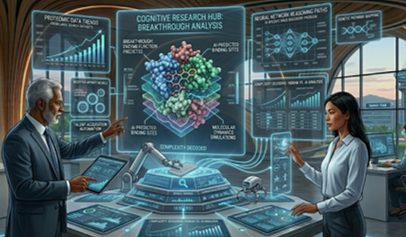
Researchers reported breakthroughs in applying AI to engineering, communications, and scientific research. AI systems are helping scientists analyze complex datasets, identify patterns, and accelerate innovation.
AI models are being used to predict protein structures, design materials with specific properties, and optimize signal processing in telecommunication networks. These systems can process massive datasets in minutes, a task that would take human researchers years.
This fusion of machine learning and natural sciences represents a paradigm shift in scientific methodology. By acting as a research partner, AI allows scientists to test hypotheses rapidly, opening up new pathways for discovery in materials science, biotechnology, and physics.
5. Generative AI Adoption Reaches New Industries 5
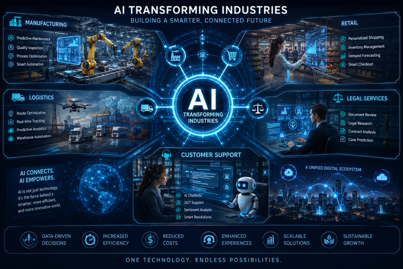
Industries including manufacturing, retail, legal services, and logistics are increasingly integrating generative AI into daily operations. Organizations are using AI to automate content creation, customer interactions, and knowledge management.
In retail and manufacturing, generative AI is optimizing supply chain management, generating product mockups, and providing personalized shopping experiences. In the legal sector, it is assisting with contract drafting and document review, reducing administrative overhead.
The expansion of generative AI into these sectors demonstrates its adaptability and economic value. As the technology becomes more accessible, it is transforming traditional business models and creating new opportunities for growth and efficiency.
Core Considerations for AI’s Practical Integration
As AI transitions from breakthrough announcements to widespread deployment, several critical themes emerge:
- AI-First Operating Systems: The transition of mobile and desktop operating systems toward native, multi-modal AI integration.
- Dynamic Strategic Planning: The necessity for organizations to build modular AI architectures to keep pace with rapid technological updates.
- Conversational Search Evolution: The growing challenge of balancing user convenience in AI search with reliable citation and content monetization.
- AI-Driven Scientific Breakthroughs: The application of machine learning systems to accelerate data analysis and pattern identification in research.
- Broadening Industrial Adoption: The integration of generative AI into manufacturing, retail, logistics, and legal services to optimize workflows.
Conclusion
May 2026 reinforced that AI is no longer a specialized technology but a core component of modern business and innovation. From search engines and productivity tools to scientific research and workforce development, AI is reshaping industries at an unprecedented pace.
The organizations that adapt quickly are likely to gain significant competitive advantages in the years ahead. Successful implementation will require not just adopting the latest models, but integrating them deeply into organizational culture and business workflows.